

Microbiome science: new pathways for health.
A systemic communication network:
Skin conditions such as psoriasis, atopic dermatitis, acne, and rosacea, long considered localized disorders, are now recognized as manifestations of systemic dysregulation involving multiple biological systems.
In this context, the brain gut skin axis (BGSA), first described in the 2010s, has emerged as a key framework for understanding these interactions. It represents a complex bidirectional communication network integrating neuroendocrine, immune, and microbial signals.
While the gut brain and gut skin axes have long been studied separately, they in fact form an interconnected triangular system. This model highlights the role of factors such as stress, gut dysbiosis, and immune imbalances in the development and progression of inflammatory skin diseases (Guo et al., 2026).
The skin as an interface of a global system:
Within this framework, the skin emerges as a key organ at the interface of these different systems. It acts as a point of convergence where signals originating from the brain and the gut are visibly expressed, contributing to the regulation of the cutaneous microenvironment (Guo et al., 2026).
The gut microbiome plays a central role in this communication. Alterations in its diversity, or dysbiosis, can disrupt immune regulation and promote a pro-inflammatory state likely to impact skin balance. Many dermatological conditions, such as acne, atopic dermatitis, psoriasis, and rosacea, have been associated with imbalances in the gut microbiota (Mahmud et al., 2026).
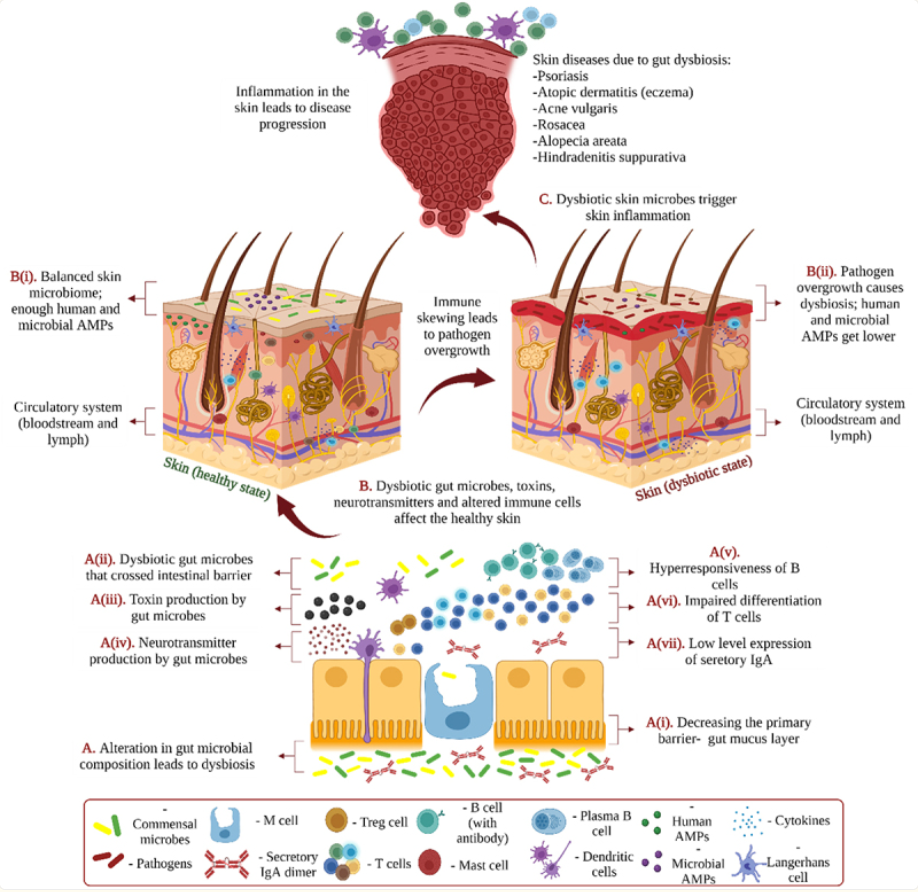
Figure 1: Mechanisms of interaction along the gut skin axis (Mahmud et al., 2022).
As illustrated in the figure below, this interaction relies on several interconnected mechanisms. Gut microbiota dysbiosis can increase intestinal permeability, notably by reducing the mucus layer and promoting the translocation of microorganisms or metabolites into the systemic circulation. It can also disrupt immune responses by altering lymphocyte differentiation, immunoglobulin production, and B cell activation (Mahmud et al., 2022).
These systemic alterations can in turn affect the skin at a distance. Circulating mediators, whether microbial, immune, or metabolic, contribute to disrupting the cutaneous microenvironment, promoting a shift from a healthy state to a dysbiotic and inflammatory one. This imbalance is notably associated with alterations in antimicrobial peptides and the proliferation of pathogenic microorganisms (Mahmud et al., 2022).
Interactions within the gut skin brain axis appear to be bidirectional. Recent research also highlights the importance of the skin microbiome in these interactions (Guo et al., 2026). While the influence of the gut microbiome on the skin is now well documented, the role of the skin microbiome in systemic processes remains under investigation. Some evidence suggests that microorganisms residing on the skin surface may modulate immune responses beyond the skin, notably through the circulation of immune cells between the skin and other organs. Conditions initially considered localized, such as psoriasis, have been associated with systemic inflammatory comorbidities, further supporting the hypothesis of broader interactions. However, these effects remain only partially characterized, and the precise mechanisms linking the skin microbiome to the rest of the body require further investigation (Y. E. Chen et al., 2018).
Thus, a combined approach targeting both gut and skin microbiomes may pave the way for more comprehensive strategies to restore skin balance (Guo et al., 2026).
Acne as an example:
Acne vulgaris is a chronic inflammatory condition now recognized as multifactorial and involving the brain gut skin axis.
Its pathophysiology relies on several interconnected mechanisms. Stress plays a major triggering role through the activation of neuroendocrine pathways, which can directly influence inflammation and sebum production. At the same time, diet and the gut microbiome contribute to metabolic regulation that may promote a systemic pro inflammatory state (Guo et al., 2026; Mahmud et al., 2022).
These factors converge at the level of the skin, where they alter the cutaneous microenvironment and microbiome balance. A study (Y. Chen et al., 2025) notably shows that certain emotional states are associated with specific variations in the skin microbiome, particularly in Cutibacterium and Acinetobacter, suggesting a close interaction between stress, dysbiosis, and inflammation.
Thus, acne can be considered a representative model of the brain gut skin axis, in which neuroendocrine, metabolic, and microbial factors interact to influence skin homeostasis (Guo et al., 2026; Mahmud et al., 2022).
Rethinking the impact of topical approaches:
This systemic perspective calls for a reassessment of the role of products applied to the skin. Through their direct interaction with the skin microbiome, they contribute to modulating an ecosystem already influenced by internal factors such as stress or the gut microbiota.
In this context, evaluating their impact becomes essential. At BYOME LABS, we develop in vitro models to measure the effects of formulations on the skin microbiome, supporting brands in the design of products that respect this balance, and even help correct certain dysbioses such as acne or atopic dermatitis.
Beyond product evaluation, this understanding also paves the way for more personalized approaches.
Sources:
Chen, Y. E., Fischbach, M. A., & Belkaid, Y. (2018). Skin microbiota–host interactions. Nature, 553(7689), 427‑436. https://doi.org/10.1038/nature25177
Chen, Y., Peng, L., Li, Y., Peng, Y., Dai, S., Han, K., & Xin, J. (2025). Amplicon-based analysis reveals link between adolescent acne and altered facial skin microbiome induced by negative emotional states. Frontiers in Cellular and Infection Microbiology, 15, 1543616. https://doi.org/10.3389/fcimb.2025.1543616
Guo, Z., Yang, J., Zang, R., Yang, Y., Wang, Q., & Xu, C. (s. d.-a). The brain–gut–skin axis in inflammatory and disfiguring skin diseases : Mechanistic insights, clinical correlations, and therapeutic strategies. Frontiers in Immunology, 17, 1737303. https://doi.org/10.3389/fimmu.2026.1737303
Guo, Z., Yang, J., Zang, R., Yang, Y., Wang, Q., & Xu, C. (s. d.-b). The brain–gut–skin axis in inflammatory and disfiguring skin diseases : Mechanistic insights, clinical correlations, and therapeutic strategies. Frontiers in Immunology, 17, 1737303. https://doi.org/10.3389/fimmu.2026.1737303
Mahmud, Md. R., Akter, S., Tamanna, S. K., Mazumder, L., Esti, I. Z., Banerjee, S., Akter, S., Hasan, Md. R., Acharjee, M., Hossain, Md. S., & Pirttilä, A. M. (s. d.). Impact of gut microbiome on skin health : Gut-skin axis observed through the lenses of therapeutics and skin diseases. Gut Microbes, 14(1), 2096995. https://doi.org/10.1080/19490976.2022.2096995