
Share :
Psoriasis is a chronic inflammatory skin disease that affects 1 to 3% of the world’s population. It is characterized by recurrent and persistent erythematous-squamous plaques, mainly located on areas of extension (elbows, knees), the palms of the hands and soles of the feet (1), as well as on the scalp (2). Psoriasis is one of the most common chronic inflammatory skin diseases and has a complex pathogenesis involving genetic, immune, and environmental factors. (1,2) Its etiology is not yet clear (3).
Genetic studies have identified several areas of the genome associated with psoriasis, mainly related to the skin barrier and immune regulation. However, genetics alone does not explain the diversity of the disease: environmental factors also contribute to its onset and progression (3).
The involvement or modification of the skin microbiome has become increasingly important in the pathogenesis of inflammatory skin diseases such as acne, rosacea, atopic dermatitis, and psoriasis (1). Indeed, the skin microbiome of patients with psoriasis differs from that of healthy individuals. (2)
Results vary depending on the study and analysis methods used. Nevertheless, most studies report reduced microbial diversity in psoriatic patients, with a higher abundance of Staphylococcus and Corynebacterium, while healthy skin generally has a higher proportion of Cutibacterium (3–5).
In fact, a reduction in protective commensal bacteria, such as Cutibacterium, is frequently observed. These changes reflect an imbalance in the skin ecosystem that could promote inflammation (2,6–8).
In general, this imbalance in the skin microbiome could contribute to the inflammatory mechanisms characteristic of psoriasis by amplifying pro-inflammatory responses, altering skin barrier function, and promoting autoimmunity (2). Another study suggests that this dysbiosis may contribute to the pathogenesis of psoriasis by modulating lipid metabolism, inflammatory pathways, and responses to oxidative stress (3). Certain Cutibacterium species show strong positive correlations with antioxidants, while strains of Staphylococcus and Corynebacterium are positively correlated with inflammatory mediators (3).
Another factor to consider is the itching caused by this condition. Scratching caused by itching damages the skin in psoriatic areas, allowing certain bacteria, usually present on the surface, to penetrate deeper into the dermis and even enter the bloodstream. They can come into direct contact with immune cells, which can trigger or maintain inflammation (8).
Anti-IL-17A drugs are useful to incorporate into psoriasis management because they bring the skin microbiome closer to the profiles observed in healthy subjects (4). More broadly, treatments should evolve toward personalization and be optimized according to each patient’s microbiome. (3,4)
We keep up to date with the latest advances in the literature in order to offer dysbiosis models that closely resemble real pathological conditions, in particular through biofilm culture and the reconstruction of bacterial proportions described in publications. When the data is well documented, we provide dedicated models (e.g., acne or atopic dermatitis).
This allows you to test your products on these models and document their beneficial effects in the context of dysbiosis in a robust and reproducible manner.
1. Radaschin DS, Iancu AV, Ionescu AM, Gurau G, Niculet E, Bujoreanu FC, et al. Comparative Analysis of the Cutaneous Microbiome in Psoriasis Patients and Healthy Individuals—Insights into Microbial Dysbiosis: Final Results. Int J Mol Sci. 1 oct 2024;25(19):10583.
2. Choi JY, Kim H, Min KH, Song WH, Yu DS, Lee M, et al. Bacteria, Fungi, and Scalp Psoriasis: Understanding the Role of the Microbiome in Disease Severity. J Clin Med. 16 août 2024;13(16):4846.
3. Wu F, Jiang X, Chen G, Zhang L. Integrated Microbiome and metabolome analysis reveals Microbial-Metabolic interactions in psoriasis pathogenesis. BMC Microbiol. 17 oct 2025;25:665.
4. Lv Y, Bian H, Jing Y, Zhou J. IL-17A inhibitors modulate skin microbiome in psoriasis: implications for microbial homeostasis. J Transl Med. 24 juill 2025;23(1):817.
5. Chan AA, Tran PT, Lee DJ. Quantitative Aggregation of Microbiome Sequencing Data Provides Insights into the Associations between the Skin Microbiome and Psoriasis. JID Innov. 22 nov 2023;4(1):100249.
6. Sinkko H, Olah P, Yang Y, Maia G, Barrientos-Somarribas M, Rádai Z, et al. Taxonomic and functional profiling of skin microbiome in psoriasis. Br J Dermatol. 1 mai 2025;192(5):931‑3.
7. De Pessemier B, López CD, Taelman S, Verdonck M, Chen Y, Stockman A, et al. Comparative Whole Metagenome Analysis in Lesional and Nonlesional Scalp Areas of Patients with Psoriasis Capitis and Healthy Individuals. J Invest Dermatol. 1 mars 2025;145(3):605-617.e14.
8. Wilkhoo HS, Islam AW, Hussain S, Kadam SR, Rao ZK, Singh B. Skin microbiome and inflammatory dermatoses: A focused review. Cosmoderma [Internet]. 4 oct 2025 [cité 27 oct 2025];5. Disponible sur: https://cosmoderma.org/skin-microbiome-and-inflammatory-dermatoses-a-focused-review/
Did this article appeal to you and would you like to find out more about this topic?
This site is protected by reCAPTCHA and the Google Privacy Policy
and Terms of Service apply.
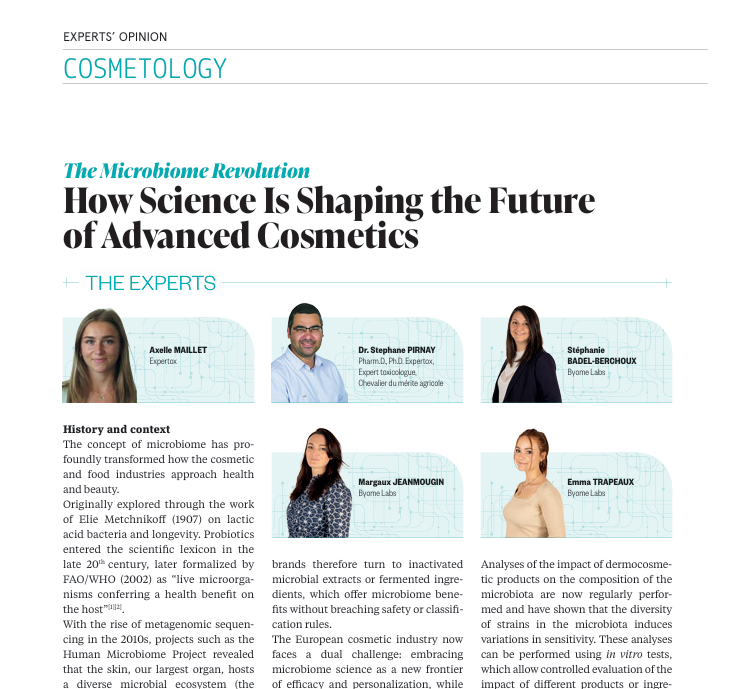
The Microbiome Revolution: How Science Is Shaping the Future of Advanced Cosmetics
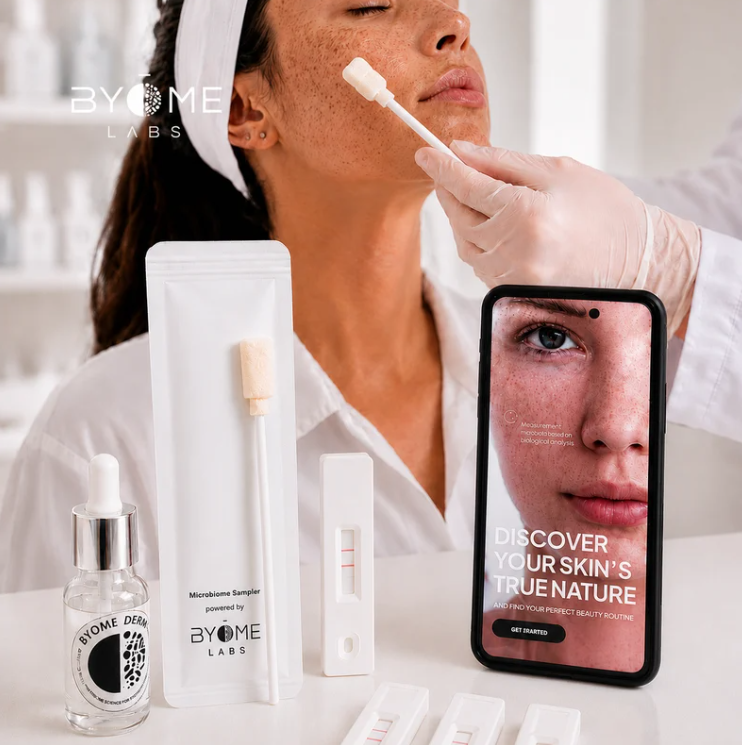
With Byome Derma, our goal is to make microbiome analysis a routine tool for better understanding individual skin needs.
In this article, we explore the brain gut skin axis and its implications for the understanding and treatment of skin disorders.

Notre site utilise des cookies pour améliorer votre expérience de navigation. En continuant à utiliser notre site, vous acceptez notre utilisation de cookies conformément à notre politique de confidentialité.

